
Operations
AI for plumbers: what to hand over, what to buy, what to skip
AI for plumbers, triaged. Three things to try free this week, the one thing worth paying for, and what to keep away from AI entirely.

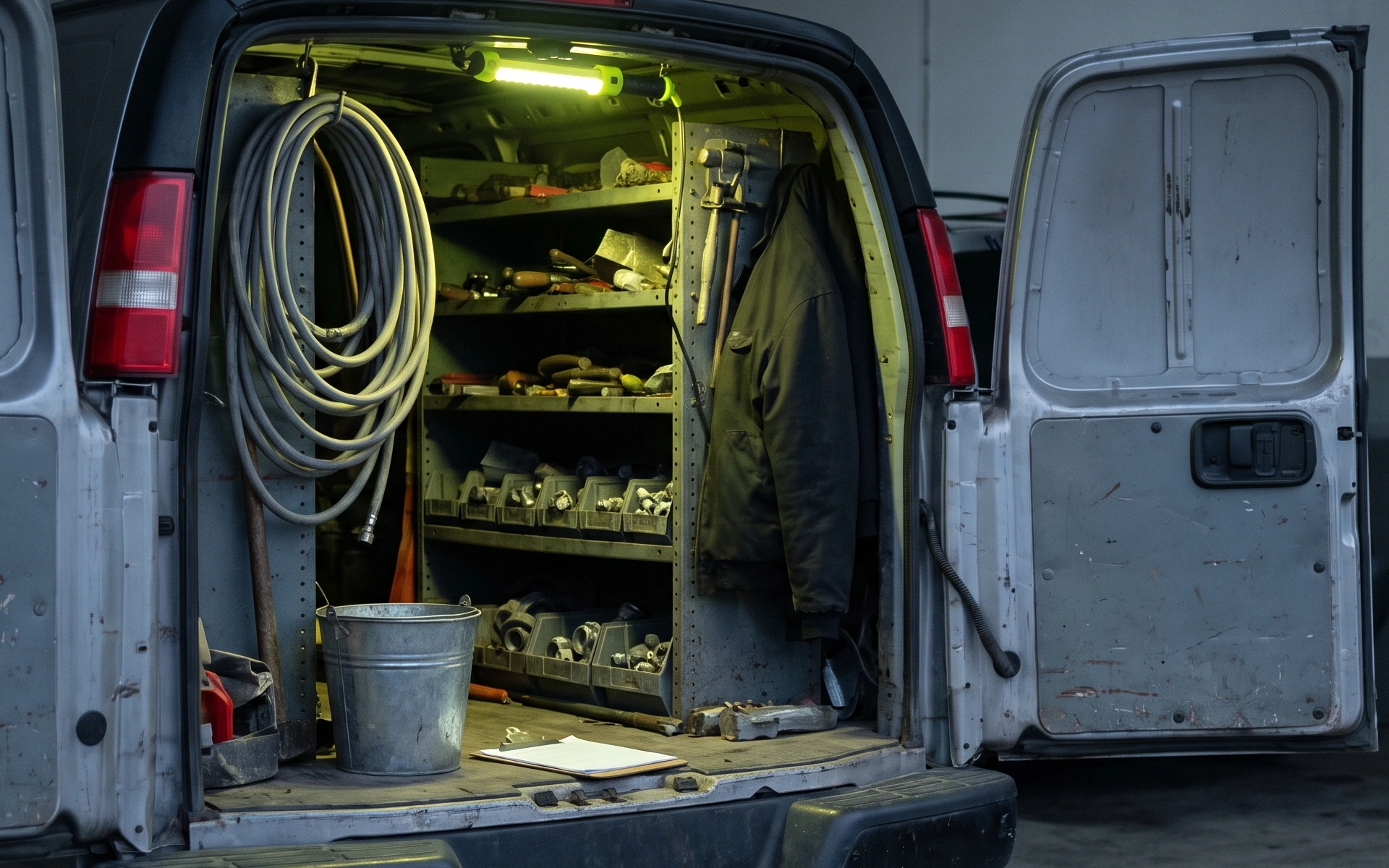
Three trucks out. A phone ringing while you're under a sink. A stack of quotes you'll write at nine tonight, because that's when it's quiet.
That's the week. So the question isn't whether AI is impressive. It's which part of that week it can take, and which part it'll make worse if you let it.
Try these three free this week
No software, no demo, no card. A free chat tool and twenty minutes.
Any of the free tiers does all three of these. Use whichever one is already on your phone and stop shopping.
1. The estimate write-up
Take a quote you already sent. Give the tool the scope, the price, and the choices the customer has. Then ask for the explanation that goes above the numbers.
This is the thing that eats your evening. It's also the only part of the quote a customer can actually read, since the rest is numbers they have nothing to compare against.
Writing one of these well is not persuasion, whatever a sales course told you. It's naming what the customer is choosing between, in words they can repeat to the other person in the room after you've driven off. That is a writing job start to finish, which is exactly why it's first on this page.
- Paste the job, not a promptThe scope, the price, the options you gave them, and one line on what you'd say to their face. Four lines of typing.
- Ask for the part you hate writingWrite the two short paragraphs that go above these numbers, for a homeowner, no sales language, and say why the middle option is the one I'd pick.
- Make it shorter and plainerCut that by a third and take out any word a plumber wouldn't say. This one instruction does more than the first two put together.
- Keep the good onePaste back the version you actually sent and tell it that's the house style. Next week's quote starts from that instead of from nothing.
Check these every time. The price, the dates, any sentence that makes a promise, and anything that names a term you didn't type. Those four are where a tool invents, and reading AI drafts is the part of this we actually do all day.
The promise is the one that bites. Give it a part and a job and it will write you a confident sentence about how long something is covered for, in the same paragraph as your own terms, in the same tone, with no flag on it. It isn't lying. It has read a great many warranties and it is averaging them. You're the only person in the exchange who knows what you actually offer, so that sentence gets read out loud before it goes anywhere.
2. Review replies
Paste the review, ask for a reply in your voice, then edit it so it sounds like you.
In your voice means you have to show it your voice. Paste your last three replies, the ones you wrote by hand, and tell it to match those. Skip that and you get the same careful apology every other contractor is posting.
One warning that matters more than the time saved. If you let it write forty replies untouched, they'll all have the same rhythm, and anyone scrolling your profile will see it. A page of identical polite paragraphs reads worse than three replies written by hand.
3. The voice note to job record
This is the one techs adopt without being asked.
At the end of a job, talk into the phone for ninety seconds. Then have the tool turn it into a job note and a customer-facing summary. A good note and a useless one are the same ninety seconds. The difference is only ever what got said out loud.
- Lead with the job number and leave the customer's name and address out of it.
- Say what you found before you say what you did.
- Read part numbers off the box, not out of your memory.
- Say what needs doing next time and roughly when it'll bite.
- Repeat anything the customer told you, in their words.
Do that and there's nothing in the recording worth protecting, which settles the privacy question for this one job. The longer answer, for everything else your crew types into these tools, is in what your team can safely put into ChatGPT.
By Friday you'll know which of the three is worth keeping. That beats a sales call as a way to decide anything.
Figure 1 / Matrix
Three jobs you can try free this week, each with the one thing to check every time it comes back.
Three free experiments
| The question | The estimate write-up | Review replies | The voice note to job record |
|---|---|---|---|
| What you give it | A quote you already sent: the scope, the price, and the choices the customer has. | The review, and your last three replies so it can match your voice. | Ninety seconds of talking into the phone at the end of a job. |
| What comes back | The explanation that goes above the numbers. | A reply in your voice, for you to edit until it sounds like you. | A job note and a customer-facing summary. |
| What to check every time | The price, the dates, the warranty wording, and anything that reads like a promise. | That it doesn't sound like every other contractor's careful apology. | That the part numbers came off the box, and no customer name or address is in it. |

The one thing worth paying for
Call answering. It's the one place where a paid product genuinely beats a free tool at your size. It's also the one most worth testing properly.
The math is boring and hard to argue with. A call that rings out is a job somebody else did. You already know that. What you almost certainly don't have is the number, and the number is what the whole decision turns on.
So count first. Two weeks of tally marks, by hour. A notepad by the phone and a tick every time nobody got to it, with the time written next to it.
Be honest about what two weeks buys you, because it is less than it sounds. It buys you the shape of a normal fortnight: which hours lose calls and roughly how many. It tells you nothing about your worst month, and your worst month is the one a vendor's annual price is really aimed at. So do the two weeks now, and do it again when you're buried. Two numbers beat one, and the notepad is the entire cost.
Then test it like a buyer instead of like someone being given a demo. Call it yourself, from a number it's never seen, at ten past five on a Friday. Describe a burst pipe badly, the way a homeowner standing in water describes one, and watch what it does with the address. That one call tells you more than the deck does.
- 2 weeksof tally marks before you call a single vendor
- 6 questionsanswered before you believe a word of the pitch
- 10 callsof theirs you listen to before you sign
Questions to put to any call-answering vendor
- What happens to a call at 5:01pm, exactly?
- How does an emergency get to a human, and how fast?
- What is it not allowed to say? Show me where I set that.
- What does it do when it mishears an address?
- Can I listen to ten real calls from a shop my size before I sign?
- What does it cost to stop, and what happens to the recordings?
Question three is the one vendors answer worst. A phone agent that promises a window you can't hit costs you more than the missed call did. Same goes for one quoting a price you don't charge.
Run it two weeks side by side with your current setup before you switch anything over. If a vendor won't allow that, you've learned something.
Figure 2 / Sequence
Six questions for any call-answering vendor, and the third is the one they answer worst.
Six questions for a call-answering vendor
What happens to a call at 5:01pm, exactly?
How does an emergency get to a human, and how fast?
What is it not allowed to say? Show me where I set that.
A phone agent that promises a window you can't hit costs more than the missed call did.
What does it do when it mishears an address?
Can I listen to ten real calls from a shop my size before I sign?
What does it cost to stop, and what happens to the recordings?
What to skip for now
Not forever. For now.
Diagnosis. It'll answer confidently about a system it can't see. What's wrong with a customer's equipment is a licensed person's call, we have no opinion on it, and that line doesn't move because software got better.
Anything that prices a job without a person. Your pricebook and your judgment are the business. If a tool offers to price a job off a photo, ask it which pricebook it used. There isn't one. It averaged whatever it read.
A tool guessing at a price is guessing with your margin.
Anything that texts a customer unreviewed. The first one goes out at 11pm to someone whose repipe you haven't finished. Find that setting on day one, before anyone has a reason to look for it.
Dispatch that reorders your day on its own. If your dispatcher holds the day together in their head, a tool rearranging it isn't automation, it's a second opinion nobody asked for. Write the dispatch rules down first, which means getting them out of your dispatcher's head. The prompt for that takes an afternoon.
Anything your own software switched on without asking. Summaries, suggested replies, a chatbot sitting on your booking page. Your field service vendor is adding these to itself and nobody sent you a form to sign. Go and look at what got turned on this month, because everything above applies to those too.
Three weeks is the number. What you do with the weekly count is the part nearly everyone skips, and it's the part that decides it.
Falling, keep going. Flat and not zero, you've found the tool's ceiling, and you want to know that before you've built a month of work on top of it. The three stages of automated spells out what comes after.
Figure 3 / Boundary
Four things stay on the skip list until three weeks of draft and approve move them off it.
What to hand over and what to skip
Hand over now
The estimate write-up
Free. Try it this week.
Review replies
Free. Write the one-star yourself.
The voice note to job record
Free. Ninety seconds at the end of a job.
Call answering
The one paid category. Count missed calls for two weeks first.
Skip for now
Diagnosis
It answers confidently about a system it can't see.
Anything that prices a job without a person
It didn't use your pricebook. It averaged whatever it read.
Anything that texts a customer unreviewed
The first one goes out at 11pm.
Dispatch that reorders your day on its own
Write the dispatch rules down first.
The lineThree weeks as a draft a person approves. Count what you fixed.
What a bad answer looks like
Your techs need this more than they need prompts. Four tells.
- A part number or a model number you don't recognize. It made it up.
- A time window nobody agreed to. "First thing" is not a window.
- A price, any price, that didn't come from your pricebook.
- Warranty or code language that sounds official. Read every word of that, every time.
The objection you'll get back is that nobody has time to check all that. Fair enough, and three of the four aren't checking, they're glancing. A part number you know or you don't. A window you agreed to or you didn't. A price out of your book or out of thin air. Only the warranty wording takes actual reading, and that one goes out under your license.
Run it as twenty minutes at a Monday meeting. Read the four tells out, then show them one bad answer you kept on purpose, off one of your own jobs, with the invented part number still sitting in it. A tech who has seen one will catch the next one.
There's a four-week version of that if you want the longer plan.
The office or the field?
Be honest about which problem you're solving, because the two need different answers and only one of them is on this page.
| Where it hurts | What you see | Who owns the fix | Would we take the work? |
|---|---|---|---|
| In the office | Calls ringing out, quotes going out late, invoices nobody chased | Writing and checking, which is ours | Yes, and we would start this month |
| Out in the field | Callbacks, techs waiting on parts, jobs running long | You, your schedule and whoever trains your crew | No, and we would tell you so on the call |
Quick way to tell which side you're on. Pull last month's callbacks and sort them into two piles: came back because something was written down wrong, and came back because something was done wrong. Most owners can do that from memory in ten minutes.
If the written pile is bigger, everything above is yours, and the order it's in is the order to do it in.
If the done pile is bigger, close this tab. Whatever fixes that is a trade problem in your building and we would be guessing at it, which is a thing we try not to do out loud. What we can tell you is what AI does to it, which is nothing: you get faster paperwork about the same callbacks, and any software claiming otherwise is selling to the wrong problem.
So which is it? If the answer is "both, probably", that's honest, and it's exactly why the next step matters.
The free AI readiness check is twenty questions, one tap each, about four minutes. Your finding and all five areas land on screen when you finish, and it names what it ruled out. For a shop, the ruled-out list is the useful half.
Do you need us for any of this?
We train crews on this, we build the thing that drafts and checks, or we run it for you. Same three routes as any other business, and the trades version is usually the simplest of the three to start.
None of the free experiments above need us. If one of them works and you want the next ten, that's the conversation, and twenty minutes of it costs nothing.
If you run HVAC as well as plumbing, the seasonal version of this is in AI for HVAC companies.