
Operations
AI for HVAC companies: a playbook that follows your season
AI for HVAC companies, by season. Peak is a phone problem, the shoulder is renewals, the slow weeks are when you build. What to use it for in each.

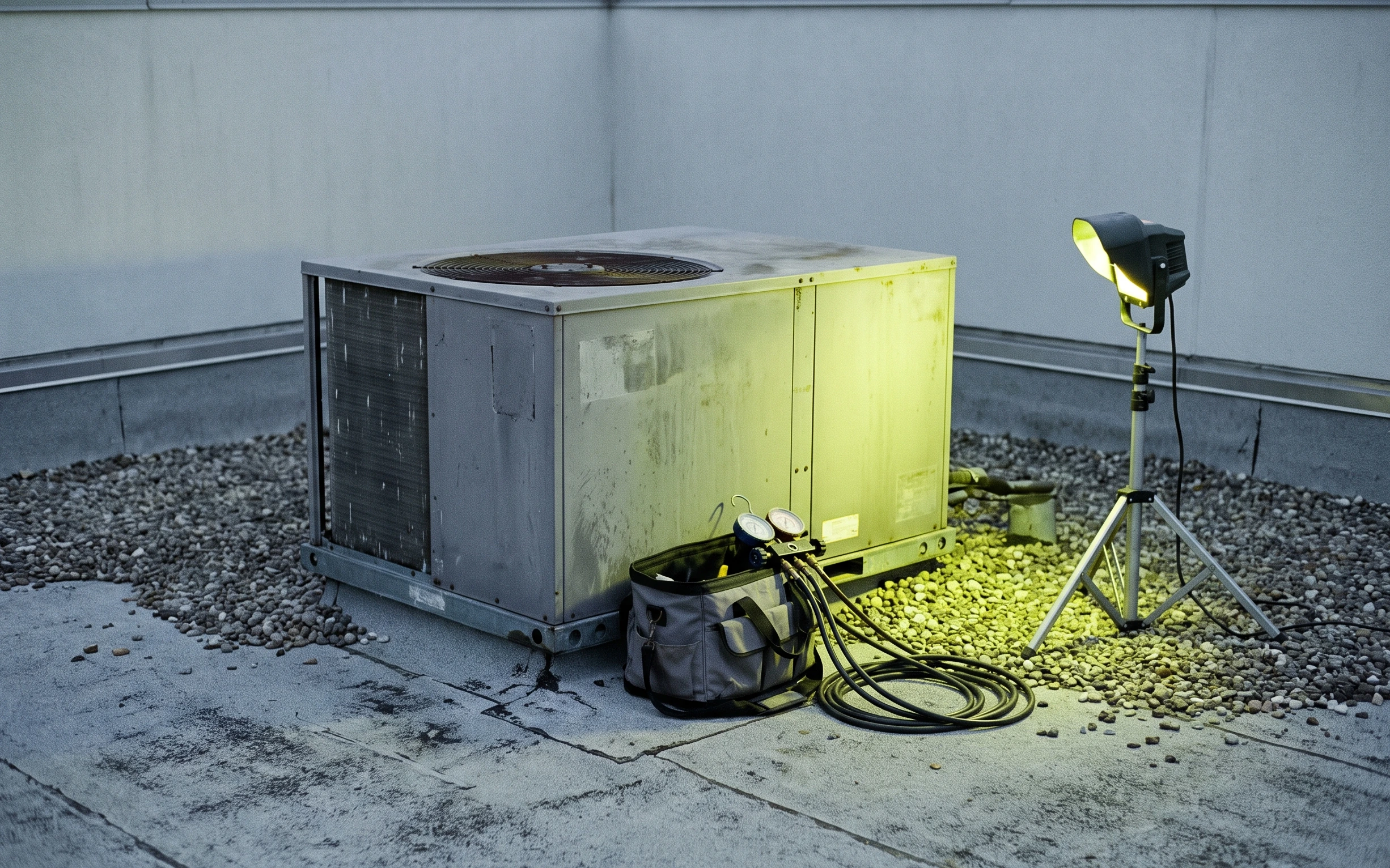
Your year doesn't have twelve months. It has four parts, and each one breaks the business in a different place.
This page is about running an HVAC company. Three to fifteen trucks, a dispatcher who holds the day in their head, and a phone that behaves nothing like itself in February.
So the playbook follows the season, because the season is the only thing that reliably changes.
Peak: it's a phone problem
In a heat wave your problem isn't marketing and it isn't closing. The phone rings more times than you can answer, and every call that rings out is a job somebody else did today.
Three things worth running in peak, and one rule that overrules all three.
The text back to the calls you missed
Pull the numbers that rang out. One text each. Honest beats fast, and the honesty is the entire trick. The one we'd send reads like this: "This is [name] at [company]. We saw your call at 1:40. We're booked out on no-cool calls today, so here's the truth. I can get a tech to you tomorrow between eight and noon, or put you on the cancellation list and call you the minute something opens. Reply 1 or 2."
That's the one a tool can draft forty of in a minute while your dispatcher is on another line. What it must never do is pick the window. The window came off your board.
Read the batch before it sends. You're checking one thing: that no text promises a time nobody agreed to.
Status texts on the jobs you did book
Nobody counts the calls asking where the tech is. Your dispatcher absorbs them, in the middle of the hour she needed for something else.
You can answer most of those before they get made. The text has to contain the tech's first name and a real time, because "on the way" from an unknown number is why the customer calls anyway.
Voice note to job record
A tech talks into the phone for ninety seconds at the end of the call. It comes back as a job note and a customer summary.
The thing that makes it usable is what gets said out loud, in order: the job number, what they found, what they did, the model and serial read off the plate rather than off memory, and what's going to bite next and roughly when.
Leave the name and address out of the recording. That's ten seconds of discipline and it settles the privacy question for this job entirely. The longer answer, for everything else your crew is pasting into these tools, is in what your team can safely put into ChatGPT.
Nothing automated gets to promise a time window. Your dispatcher owns the clock.
A machine that commits you to four o'clock has made a decision that costs you a truck roll and a review. Find that setting on day one of any trial, before anybody has a reason to go looking for it.
Figure 1 / Flow
In a heat wave the unanswered call is the job somebody else did, and the only thing that never gets automated is the clock.
From a missed call to a kept time
Needs a person
The call you could not answer
A call that rings out is a job somebody else did today.
Automated
A short honest text, with a time you can keep
One text each. Read the batch before it sends.
The rule for peak
Your dispatcher owns the clock
Nothing automated gets to promise a time window.
- Needs a person
- Automated
- Affirmed

Shoulder: the renewals nobody gets to
Here's the most valuable AI job in this trade, and it's the dullest one on the page.
Maintenance agreement follow-up. The list exists. You know it exists. In April it sits fourth behind three things that are actually on fire, so it slips, and renewals quietly fall off the back of the year.
The reason the generic version of this fails is that it reads like a form letter, because it is one. What makes it land is four fields off your own records, pasted in per customer.
| Field | What goes in | What it does in the message |
|---|---|---|
| Last visit | The month, not the exact date | Proves a person looked before writing |
| What was done | Coil clean, capacitor, blower wheel | Turns a mailshot into a service history |
| What the tech flagged | The watch-it note off the job record | Gives them a reason that isn't the calendar |
| What they paid | Last year's agreement price | Lets you name the renewal number up front |
The flagged item is the one that does the work. "Last March your blower wheel was packed and we cleaned it, so that's the one I'd watch going into this summer" is a sentence no mailshot produces, and it came off a job note somebody already wrote.
Twice a year, in whichever weeks your own calendar calls quiet, and before the season turns rather than after. The only part of that we'd argue for is the "before": a renewal letter that arrives once somebody already needs you is a different letter.
And if a customer replies with a question about their equipment, that reply goes to a person. The draft got them to the conversation; it does not get to have the conversation.
Slow: the weeks that pay for July
Your slow weeks are when you build what your busy ones spend. You already know that, which is why it's irritating rather than useful to be told. It doesn't happen because slow weeks fill up with everything that got deferred out of the busy ones, and nothing on that list has a customer attached to it.
Three things to write down while there's time.
The replacement quote template. Three options, and here's the part everybody skips: name them by what the homeowner gives up, not by good, better, best. "Good, better, best" makes a customer guess what the difference is, and a guessing customer picks the cheapest one and then resents it. Say what the cheap one costs them later, in your own words and your own numbers, and say which one you'd put in your own house. Write both sentences once, in a quiet week, and stop rewriting them at a kitchen table at ten at night.
The renewal script. The four fields above, plus the paragraph that goes around them. Written now, the shoulder-season batch is an afternoon. Written in April, it's a week you don't have.
The dispatch rules in your dispatcher's head. This is the big one, and it has its own page. Until those rules exist on paper, no software can help with your schedule, and the business has a single point of failure who occasionally takes a vacation.
The prompt and the five-step check is the fastest route through all three. The check is the half that makes them true, and it's the half people skip.
The week after a storm
This part is different, because the rules you just read change.
Demand goes vertical. Your lead time is bad news you have to deliver, over and over, to people who are cold or hot and not interested in why. Your reputation that month is made almost entirely by how clearly you explain a wait.
That's a writing problem, which makes it the one thing these tools are genuinely good at under pressure. Draft three messages in advance.
One: we are at capacity this week, here is the earliest honest date. Two: here is where you sit in the queue and what moves you up it, which is a sentence you can only write once the rule above exists. Three: here is what to do about the house until we get there, and that one you write yourself, because it is the only one of the three with your license behind it.
The third message is where a tool will cheerfully hand you advice about space heaters and open flames. Write that paragraph once, by hand, get your own person to read it, and then never let anything regenerate it.
Figure 2 / Matrix
The year has four parts, not twelve months, and the slow part is where you build everything the other three spend.
The year in four parts
| The question | Peak | Shoulder | Slow | The week after a storm |
|---|---|---|---|---|
| What breaks | The phone rings more times than you can answer. | Renewals sit fourth behind three things that are on fire, so they slip. | Slow weeks fill with everything that got deferred out of the busy ones. | Demand goes vertical, and a wait has to be explained. |
| Run or build | Run: the text back to the calls you missed, status texts on booked jobs, the voice note to job record. | Run: maintenance agreement follow-up, drafted from four fields and read as a batch. | Build: the replacement quote template, the renewal script, and the dispatch rules in your dispatcher's head. | Build: three messages drafted in advance, and who jumps the line decided in writing. |
The replacement quote
The biggest ticket in your business, and it gets read at a kitchen table at ten at night by two people who are tired.
AI helps with exactly one part of it, which is the explanation above the numbers.
Three options, what each means for this house, and what the customer gives up by taking the cheaper one. That's an hour of your evening, and it's the part that wins the job off a competitor who emailed a bare total.
What it never touches: the model numbers, the capacity, the load calculation, and any claim about what the equipment will do once it's in. Those four come from your licensed person and your supplier, and a tool will invent all four with total confidence and no flag.
The capacity number is the one that bites, and it bites in a specific way worth understanding. Ask about a system for a square footage and it answers. Immediately, in the same tone it uses for the weather, having never seen the house, the windows, the ductwork or the attic. There is no hedge and no flag, because the tool has no way of knowing what it doesn't know. That is the behavior to teach your people, not the number.
Figure 3 / Flow
On a replacement quote a tool writes the explanation and nothing else; the numbers come from a licensed person and a pricebook.
Who writes which part of the quote
Your licensed person
Capacity and load calculation
And the model numbers. A tool invents all of these.
Recorded
The price, from your pricebook
Automated
Explaining the three options
The two paragraphs above the numbers.
Affirmed
What cheaper gives up
What the customer gives up by choosing the cheaper one.
- Needs a person
- Recorded
- Automated
- Affirmed
The never list
Four lines. Print it and put it on the office wall.
- No sizing. A load calculation belongs to a licensed person and to the building it's in.
- No diagnosis. A code lookup is a memory aid. What's wrong with the unit is the tech's call.
- No time windows from anything automated, ever.
- No price or capacity claim that didn't come off your pricebook or your supplier.
Everything outside those four lines is writing, listening and keeping lists, which is exactly where these tools are strong.
A tech who has seen one bad answer catches the next one. So keep one. The next time a tool hands you a part number that doesn't exist, screenshot it, and read it out at a Monday meeting with the invented number still sitting in it.
Figure 4 / Boundary
Four lines never move, because a load calculation and a diagnosis belong to a licensed person and not to a tool.
The four lines
Writing and listening
Everything outside those four lines
Writing, listening and keeping lists, which is where these tools are strong.
The never list
No sizing
A load calculation belongs to a licensed person and to the building it's in.
No diagnosis
A code lookup is a memory aid. What's wrong with the unit is the tech's call.
No time windows
From anything automated, ever.
No price or capacity claim
Unless it came off your pricebook or your supplier.
The lineSizing and diagnosis belong to a licensed person, not to software.
Count two numbers before you buy anything
Not one number. Two, and they have to come from opposite ends of your year.
Missed calls per week in your busiest month. Missed calls per week in your slowest. A notepad by the phone, a tick and the time, two weeks in each.
A vendor quoting you one annual figure is pricing the average of those two. Your business does not operate at the average. It operates at the top in July and at the bottom in February, and the subscription runs through both.
| Ask this | A good answer sounds like | Walk away if |
|---|---|---|
| Can I pause, and what does it cost? | A named monthly figure to keep the number and the settings | Pausing means starting over |
| What happens to my script while it's off? | It sits there and comes back as you left it | You rebuild it every spring |
| Is there a month to month term? | Yes, at a higher rate they'll say out loud | Annual only, no exceptions |
| What happens to a call at 5:01pm? | A specific, boring, checkable answer | Anything about intelligent routing |
Then test it yourself before you sign. Call the number from a phone it has never seen, at ten past five on the Friday of a heat wave, and describe a dead condenser badly, the way a homeowner standing in a hot kitchen describes one. Watch what it does with your address. That one call tells you more than the demo did.
Which is it for you?
Here's the question that decides your next move, and it is harder than it sounds from where you're sitting.
Is it the phone, the schedule, or the fact that everything that matters lives in two people's heads? Those take three different answers, and in July they feel completely identical from the owner's chair.
The free AI readiness check is twenty questions, one tap each, about four minutes. Your finding and all five areas land on screen when you finish, and it names what it ruled out. For a seasonal business, the ruled-out list is the half that saves you money.
If you want help with the season
Three routes. We train your office and your techs on this. We build the writing and the checks into how the work runs. Or we run it for you through your season.
For an HVAC company we'd start with the slow-season writing every time, because it's the thing that makes everything after it possible.
If you run plumbing alongside the HVAC side, the triage version of this is in AI for plumbers. And if you're weighing whether to pay anybody at all, that question has its own page, including when the answer is nobody.